Retreat Website: What It Needs to Get Bookings
If you sell your own retreats, your website has a bigger job than looking lovely. It's where people go to find out what the week is, when it runs, what it costs, and how to save a spot. When those answers are hard to find, interested people tend to drift away quietly.
This guide walks through what a booking-ready retreat website needs, piece by piece, so you can check your own site with fresh eyes. One honest note first: a website doesn't create demand by itself. People still need to hear about you somewhere. What a clear site does is give the people who already care an easy place to say yes.
A sales page is one page. Your website is the home base.
A sales page sells one dated retreat and helps the right person book that week. Your website holds everything around it: every retreat you offer, your story, your email list, your guest terms, and a way back for people who have already traveled with you. We cover the single page in our guide on how to write a retreat sales page.
For a first retreat, a link-in-bio or one simple page can honestly be enough. It usually starts to feel thin once the business grows a little. A second date appears, you open a waitlist, or a past guest wants to know what's next and can't find it. That's often when a proper home base starts to earn its place.
What a booking-ready retreat website needs
Nine pieces tend to do most of the work. You don't need to fix them all in one weekend.
Offer clarity on the first screen
The first thing a visitor sees should say who your retreats are for, what the experience is, and roughly where and when it happens. Plain words usually work better than poetic ones. If a stranger could read it once and repeat it to a friend, you're in good shape.
If you haven't settled on that sentence yet, our branding guide shows how to write a one-liner that names the guest.
Check yours: ask a friend who doesn't know your work to glance at your home page, then tell you what you offer and who it's for.
Dates and pricing people can actually find
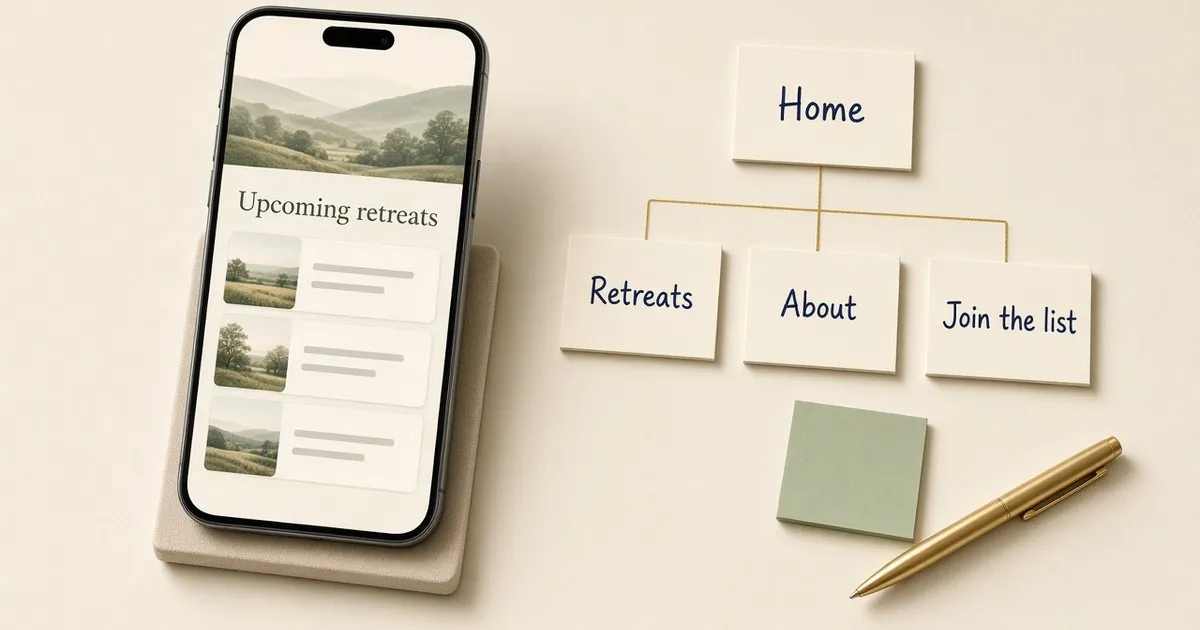
Visitors usually want two answers straight away: when is it, and what does it cost. An "Upcoming retreats" section handles both. Give each retreat a card with the dates, the location, and a starting price or a clear "from" line, and link each card to that retreat's sales page.
Past retreats are a nice way to show what your weeks look like, as long as they're clearly labeled as past. If you're still working out the numbers, our guide on how to price a retreat walks through it.
Check yours: starting from your home page, see how quickly you can reach the next date and its starting price.
One booking path and a clear deposit step
Each retreat should have one main action, and it should be the same everywhere it appears. For most dated retreats that's booking with a deposit. For an application-based retreat, it's applying or sending an inquiry.
Near that button, say plainly what the deposit holds and where the full terms live, and keep those terms in one place. If you offer installments, describe them simply: when payments are due and what happens if one is late, and make sure the terms read the same on every page where they appear.
Behind the button you'll need something that takes the payment and keeps the guest record. Here's how customer relationship management (CRM) and booking software split that job. Ideally the booking happens on a page with your name on it rather than on large third-party directories, and we explain why the booking should happen on your own page separately.
Check yours: click your booking button on every page where it appears and make sure each one lands in the same place.
Email capture for people who aren't ready yet
Many visitors won't be ready to book on their first visit. They may need to check dates or get to know you a bit more, and a site that only offers "book now" lets them slip away.
Give them one honest reason to join your list, such as a waitlist for the next date or a genuinely useful guide. We share ideas for a lead magnet worth signing up for in another post. Make the opt-in easy to find on the home page and retreat pages, and consider the footer where it fits the design.
From there, think about what to send once they join.
Check yours: sign up on your own site from your phone and see whether the confirmation arrives.
Trust and proof
People are about to trust you with a week of their life and a deposit, so they want to know who you are. Real photos from real retreats help most. If this is your first retreat, venue photos are fine, labeled clearly so nobody assumes they show a past group. A short founder story, what's included, and an easy way to reach you all help.
Guest words are lovely when you have them, shared with permission. Please never invent a testimonial, a guest count, or a press logo. A modest amount of honest proof serves you well, and anything made up can quietly undo the rest.
Check yours: look at every quote, number, and logo on your site and make sure you could say where each one came from.
Built for the phone first
Many people will meet you on a small screen first, often in between other things. So test the booking path and the email form on a phone, start to finish. Buttons should be easy to tap. Dates and prices should be readable without zooming. The checkout should fit the screen, with simple fields and no pop-up that refuses to close.
Check yours: on your phone, go from the home page to a completed test booking or sign-up without switching to a laptop.
Fast enough not to lose people
Large photos are a common cause of a slow page, so resize and compress them before you upload. Avoid autoplaying a heavy video at the top of the page. Each embedded extra, like a social feed or a chat bubble, adds weight, so keep the ones that genuinely help.
Check yours: open your site on mobile data and notice whether you find yourself waiting.
Legal pages and guest terms
A privacy policy, website terms, and guest booking terms all belong on the site. Guests care most about the booking terms: cancellation, refunds, transfers, and payment deadlines. Make them easy to find from the footer and next to the booking button.
Have these reviewed by a qualified local advisor, since the right wording depends on where you and your guests are. This article isn't legal advice. For the wider picture, see our guide to legal essentials for hosting a retreat.
Check yours: from the booking page, see whether a guest could find your cancellation terms in one tap.
Tracking you'll actually look at
A few simple measures tell you most of what you need: where inquiries came from, how many people reached the booking step, how many joined the list, and how many paid a deposit. A basic analytics tool, together with your booking and payment records, usually covers it.
If you run ads, install the relevant tracking before launch and configure it in line with your privacy and consent requirements. Then look once a month and change one thing at a time.
Check yours: see whether you can say where your last few bookings came from.
The short page list
These pages cover the essentials:
Home
Upcoming retreats, with one sales page for each retreat
About
Contact or inquiry
Join the list or waitlist
Guest terms and policies
A page for past guests, or a simple "what's next" page, is optional and a warm way to bring past guests back.
Why build your own systems instead of hiring someone to fill retreats for you
At some point you may consider paying a retreat planner or coach who fills the retreat for you. Some of that help is genuinely useful, and many people in this work do it well. A fair question to ask is what you'll own when the work is done. If guests came through someone else's audience, list, page, or booking system, you may retain less of the audience, data, and infrastructure for the next retreat. If they came through your website, your email list, your CRM system, and your booking path, each retreat can make the next one a little easier.
Ownership
Your domain, your site, your email list, and your guest records can stay yours, whoever helps you along the way. If you change advisors, take a season off, or a platform you relied on changes course, those pieces stay with you. That's why your own booking system matters. Owning them isn't risk-free, since sites need upkeep and tools change, but you're the one holding the keys.
Margin
When someone else's channel sells the seat, there's a cost: some outside channels charge per booking or take a commission, while others charge retainers or project fees. Your own systems still cost something in time, tools, or setup help. The difference is that you build them once and maintain them, and they keep serving every retreat after that.
Guest relationships
When the booking relationship and follow-up live in systems you control, it is easier to maintain an ongoing relationship with guests who have agreed to hear from you. You can invite them back, ask whether they know someone who'd enjoy the next retreat, and hear honestly what they'd change.
Repeatability
A system you own lets your second and third retreats reuse the same pages, list, follow-up, and booking path. If the audience and booking route live primarily with an outside provider, you may need to re-engage that provider for future dates, and it may not be available on the same terms next year.
Outside help can be valuable. The stronger setup is one where that help builds assets and systems you continue to control: your domain, pages, CRM, list, booking path, reporting, and follow-up. At Book Wellness Retreats, we build retreat sales pages and full websites with booking built in, and leaders who prefer to do it themselves can build their website in MyAura, where bookings, payments, and the guest list live in one place. See our current packages.
For retreat centers: what changes on a property site
A retreat center's website has two audiences. Some visitors want to book a stay or join a program. Others are retreat leaders looking for a place to host their group. Give each a clear path from the home page.
For guests, show a calendar of hosted programs with dates and links. For leaders, add a "host your retreat here" page that explains what the venue offers: rooms in plain terms, practice and meeting spaces, meals, how group bookings and deposits work, and who to contact. Photos of the actual spaces matter even more here.
If guests book rooms online, a property booking system handles work a leader's site doesn't need, like room inventory and availability. You can read more about property management software for retreat centers. Filling the calendar is its own topic, covered in our guide to retreat center marketing.
A ten-minute check of your own site
Grab your phone and go through these questions. A "no" simply shows you where to start.
Does the first screen say who your retreats are for and what they are?
Can you see the next date and a starting price without hunting?
Are past retreats clearly labeled as past?
Does every booking button lead to the same place?
Can visitors join your list or waitlist from each retreat page?
Is every photo, quote, and claim on the site real and used with permission?
Can you finish a test booking or sign-up on your phone without frustration?
Does the site load comfortably on mobile data?
Are your cancellation and refund terms one tap from the booking button?
Do you know where your recent inquiries and bookings came from?
A clear offer, visible dates, one booking path, a list, honest proof, and systems you own can make each retreat a little easier to run and sell than the last. Your website is one piece of that system. When you're ready to look beyond the site, we've mapped out the rest of the launch plan.
We've worked with retreat leaders and venues on the website, booking, and follow-up side of their business, and we're happy to talk through what you're building. If you'd like a second pair of eyes on your site and booking path, book a discovery call. We can review the page, booking path, and follow-up with you.