Retreat Marketing Partnerships
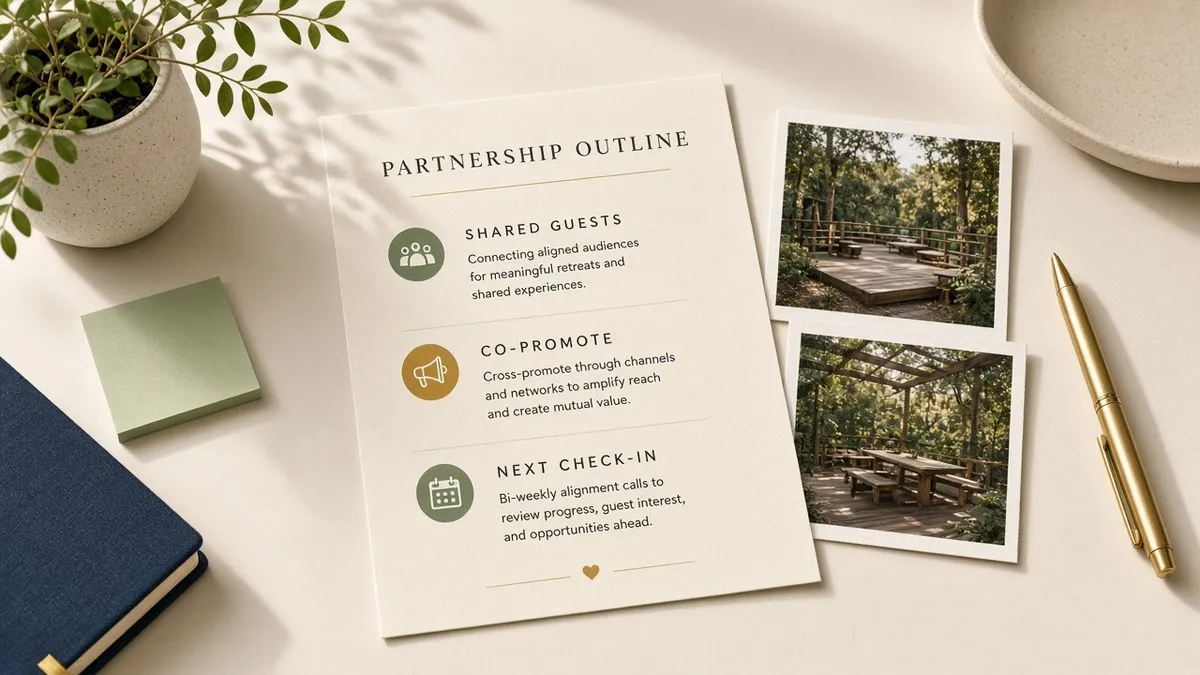
You do not have to market every retreat alone. Retreat marketing partnerships can introduce your offer to people who already follow a teacher, creator, or local provider whose audience overlaps with your guests. A useful partnership is clear about what each side will do, how inquiries are handled, and how content may be used. Partnerships can widen who hears about your dates. They do not guarantee a full house.
This article covers how to choose partners, how to tell audience introductions apart from production services, how to set up local add-ons without assuming promotion, how to document the arrangement in writing, and how to run a small pilot you can actually review. Shared leadership and money roles are a different conversation; we cover that in how to co-lead a retreat . Here the focus is marketing partnerships that support enrollment without confusing the guest.
Choose Partners Whose Audiences Fit Your Retreat
A good partner already speaks to people who could be a fit for your retreat. They care about similar standards for teaching, hospitality, and how guests are treated. When they introduce your retreat to their audience, the mention should feel consistent with what those people expect from them.
A large following that rarely engages with yoga, rest, or the kind of teaching you offer may create more noise than useful inquiries. Spend time on fit before you spend time on posting calendars. Look at public comments on their work, relevant past collaborations, and any audience description the partner is willing to share with you. You do not need a scoring spreadsheet. Ask a practical question: would you be glad if a guest arrived because of this person?
A partner introduction is not a transfer of their subscriber list. They do not hand you their mailing list, and their audience has not given you permission to email them. Route interested people to your booking page or an opt-in form you control. Share contact details between you and the partner only when the person has agreed to that handoff.
When the fit looks real, agree on a specific introduction: a post, an interview, a newsletter mention, or another format you both understand, with a working link to your offer. You still own the dates, the terms, and the booking experience on your side.
Choose the Right Type of Collaboration
Not every collaboration is the same job. Separate people who can introduce you to an audience from people who help you produce assets.
Audience introductions. Wellness creators and bloggers who already write or film for people like your guests can share an approved description, answer common questions, or point to your sales page. Social posts and short interviews can sit beside your own social media for retreats plan. Give accurate details and a clear link. After someone discovers you through a partner, email marketing for retreats is often where the next useful message lives when they have opted in with you.
Directories and listing-style placements. These can put your dates in front of people already browsing retreats. Terms vary. Before you commit, check fees, whether the directory earns a referral or takes the booking, and who answers guest inquiries. Do not assume you will always own checkout or guest data. Read the agreement. If a guest wants a call after an introduction, how to run a retreat discovery call covers that conversation on your side.
Production services. Photographers and visual partners capture usable assets: rooms, teaching moments, meals, landscape, and guest-safe images when everyone has consented. That work supports your sales page and emails. It is not the same as delivering prospects. Agree who owns the files, where they may be used, for how long, and whether credit is required. Credit is not the same as permission to reuse.
Choose the collaboration type that matches the outcome you need. An introduction partner and a photographer can both be valuable; they solve different problems.
Local Add-Ons and Optional Promotion
Local providers can improve the guest experience: spas, guides, artisans, surf instructors, cultural hosts, and nature operators near the venue. Buying their service does not automatically mean they will promote your retreat. If you want promotion, agree that separately, with the same clarity you would use for any other collaborator.
For example, imagine a coastal yoga retreat that adds an optional afternoon with a local surf school. Guests who want the session book a limited number of spots through you or through the school, depending on what you agreed. The school is paid for the lesson. Promotion on their channels is a separate yes or no, with dates and links written down if they say yes. That example is hypothetical; use it as a shape, then fill in your real providers and terms.
When you add a local experience, clarify whether it is included in the retreat price or optional, who takes payment, how many guests can join, what skill or access requirements apply, how cancellations work if weather or staffing changes, and who is responsible on the day. Choose add-ons that match the retreat theme rather than every activity available nearby. Local partners still sit inside a longer marketing calendar; we cover timing in how long to market a retreat .
Document the Arrangement in Writing
Document the scope in writing before work starts. The form should suit the arrangement: a short written summary may work for a simple mention; a fuller agreement may be appropriate when money, travel, image rights, or guest data are involved. Do not treat a checklist as a complete legal agreement.
Cover at least:
Deliverables and dates. What each side will publish or deliver, on which channels, and by when.
Compensation. Paid fee, complimentary seat, trade, or mutual promotion - named clearly, including what a hosted seat covers and what it does not.
Cancellation and non-delivery. What happens if either side cannot deliver, or if the retreat dates change.
Content approval. Who reviews copy and images before they go live, and how long that review takes.
Ownership and permitted use. Who owns photos and content; whether the other party may reuse them; on which channels; for how long; whether edits or paid ads are allowed. Ownership is not the same as reuse permission. Credit is not the same as reuse permission.
Guest image consent. How guest photos and names may be used, and what requires separate consent.
Inquiry handoff. Whether interested people go to your form, your email, or a tracked link, and who answers first.
Disclosure. How a creator will clearly disclose payment, a complimentary stay, or another material benefit when that applies.
For endorsements directed at people in the United States, the FTC endorsement guides are a practical starting point for how to disclose material connections: FTC endorsement guides . Agree the disclosure wording with your partner before they post.
Name one owner on your side for follow-up so partner and guest messages from the collaboration do not sit unanswered.
A Small Pilot You Can Review
Here is a clearly hypothetical small pilot. A relevant yoga teacher agrees to share an approved short introduction with her own subscribers and link to your offer page. Before anything sends, you both agree on the send date, whether there is compensation, how she will disclose any payment or complimentary stay, and which link she will use. Your goal for the pilot might be a handful of serious inquiries you can answer within a few days - not a full retreat booked from one email.
After the send, review qualified inquiries and bookings that came through that path, alongside the cost and effort on both sides. A tagged link can help with attribution. It does not prove those bookings would not have happened another way. Use the review to decide whether to repeat, adjust, or stop - without inventing results in advance.
A Simple Partnership Check
Before you add another collaborator, run through this short list:
Audience fit. Public signals and what the partner shares suggest their audience could be a real fit for this retreat.
Collaboration type clear. Audience introduction, directory placement, or production service - each has a defined role and outcome.
Local add-on scope clear. If you use a local provider, included versus optional, payment, capacity, guest requirements, cancellations, day-of responsibility, and any separate promotion agreement are written down.
Arrangement documented. Deliverables, dates, compensation, cancellation, approval, ownership and permitted use, guest consent, inquiry handoff, and disclosure are in writing in a form that suits the work.
One owner for follow-up. Someone on your team answers partner and guest questions that come from the collaboration, and you have a way to review inquiries without losing the guest experience.
If any of these is still open, fix it before you stack more partners.
What to Do Next
Choose partners whose audiences fit your retreat, match the collaboration type to the outcome you need, set up local add-ons with clear scope, document the arrangement before work starts, and review a small pilot with honest inquiry and cost notes.
Need help fitting partnerships into your retreat marketing plan? Explore BWR’s marketing services, or book a discovery call to discuss how partner introductions, content and follow-up could support your retreat.
For a broader plan for your retreat, download our free retreat planning guide .